

On Rice
The ample global supplies will benefit the South African consumers

It is perhaps too early to be writing about rice. But I come bringing good news. Global rice prices are under pressure due to ample supplies, see the chart below.
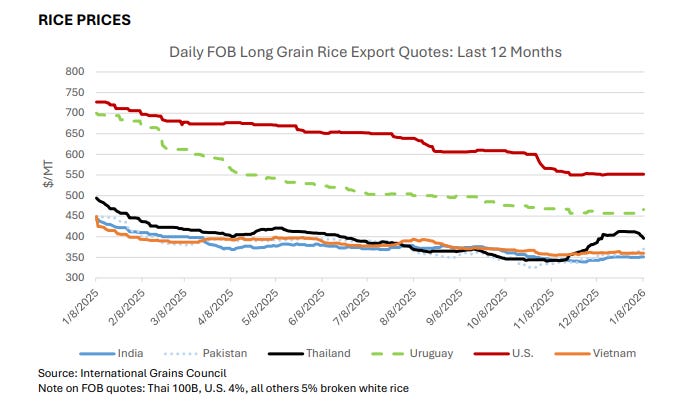
The International Grains Council forecasts global rice production for 2025-26 at a record 543 million tonnes, up 0.3% from the previous season. This is due to large-scale production in India, Vietnam, China, Bangladesh, and the Philippines, among others.
As a result of this increase in production, the stocks are up 1% year-on-year, estimated at 189 million tonnes.
We pay attention to these issues because, as a country, while we are a net exporter of agricultural products, rice is one of the products we are not endowed with. We rely 100% on imports.
We consume about a million tonnes of rice annually. We can’t produce rice because of our relatively dry environment; we are generally a semi-arid country.
Thailand is the leading rice supplier to South Africa, accounting, on average, for 74% of South Africa’s rice import volume over the past five years. India is the second-largest rice supplier to South Africa, with an average annual share of 21% over the past five years.
Other rice suppliers to South Africa include Pakistan, Vietnam, China, Australia, the US, and Brazil.
Therefore, this reliance on imports means we should constantly monitor global price developments. Indeed, this time around, rice price prospects are expected to continue softening due to abundant supplies and minimal trade disruptions.
All else equal, the coming months will likely see much better, sustained moderation in global rice prices. This will benefit importers like South Africa, and bodes well for consumer food price inflation, especially when grain prices also moderate on the back of an ample domestic harvest.