


South Africa is a net wheat importer, and October 3 marked the first week of the new 2025-26 marketing year. The imports for the first week of the 2025-26 marketing year totalled 20,362 tonnes. The suppliers were from Australia (52%), Lithuania (43%) and Poland (5%).
We expect South Africa’s 2025-26 wheat imports to reach 1.74 million tonnes, down marginally from 1.83 million tonnes in 2024-25 marketing year because of an expected slight recovery in the domestic harvest.
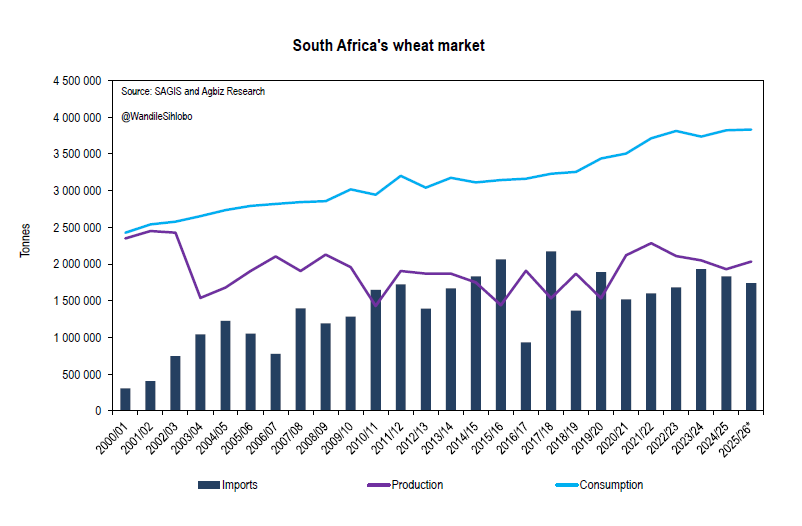
For anyone wondering why South Africa imports wheat, I must highlight some brief historical perspective I have shared here before. South Africa began importing over a million tonnes of wheat from the 2003-04 marketing year.
In the years before that, wheat imports averaged 458,518 tonnes, for example, between 1989-90 and 2002-03. The import surge resulted from increased consumption and a decline in area plantings.
From the 1997-98 season, South Africa’s wheat plantings fell below a million hectares, the norm in seasons before this period. This decline is better explained by the profitability challenges that farmers have faced since that period, specifically in the Free State and in non-conducive climatic conditions.
The critical thing to recall is that before 1997-98, South Africa’s agricultural markets were regulated, and the various commodities boards played a massive role in setting prices, including wheat.
Thus, after deregulation, South African farmers had to compete in the global market. Therefore, the Free State production areas came under profitability strain, resulting in farmers switching from wheat to other profitable crops.
Other provinces of South Africa don’t have large areas with conducive climatic conditions for high-quality wheat milling for human consumption. Hence, we speak of a few central wheat-producing provinces, including the Western Cape and those under irrigation in the Northern Cape, Free State, Limpopo, and North West.
A significant development over the years has been the improvement in productivity in South Africa’s wheat farming. In 1997-98, South Africa’s wheat yields were below 2.0 tonnes per hectare. The yields are 3,8 tonnes per hectare as of the 2024-25 production season.
Because of improved profitability, South African wheat production has remained relatively large. The 2021/22 crop was the largest in 20 years, at about 2.3 million tonnes.
In 2025-26, the crop is estimated at 2.03 million tonnes. This is insufficient to meet annual consumption. Thus, we say, South Africa will likely import about 1.74 million tonnes of wheat in the 2025-26 marketing year to supplement the domestic supplies. The current import volumes are roughly half of South Africa’s annual wheat needs of 3.8 million tonnes.
Unmandated Reflections
A View from the Periphery.
Mr Wandile Sihlobo
Thank you very much for the information. I am in the beef and mutton production. I am very much interested to look at the wheat deficit in RSA.
I am based in the north western Free State town of Koffiefontein south of Kimberly in the N12. This is a dry land farming of the red sandy soil.
Is Koffiefontein part of the wheat producing area of our Province of the Free State?
I belong to the Liberation Struggle Military Veterans of the Ex-Political Prisoners Association (AEPP RSA). We are always looking for gap markets. The wheat deficit is much interesting.
Yours sincerely
Pat Zanemvula Matosa
Amade ngawetyala!
Camagu!
Ndisatshaya!
We recently relocated to Tulbagh area in Western Cape ....expected to see vineyards and olives, were surprised by the number of fruit trees (though we knew that was "big" over the mountains in Ceres and down the Breedekloof Valley) but were totally floored by the amount of wheat. Always thought that would be found in the Swartland (over the hills in the other direction) - which of course it is.
And now we are even more surprised to learn that only 50% of our required production comes from local sources.
But talking to a local farmer yesterday did clarify some aspects for us.
Firstly wheat farms is the ultimate test of faith. The farmer trusts his instincts to determine the precise day on which he is to sow the seed - done mechanically so there is very little labour input (his main expense is the seed - so they tend to use as much as they can of their own seed from the prior harvest - though suspect that some new seed needs to be mixed in to ensure the health of the plantings). Then he has to wait for just the right amount of rain and at precisely the right time.
Secondly there is little for the farmer to do between sowing and harvesting (other than regular inspections of the fields to ensure no worm infestation or other pests) and so a huge dose of patience is required.
Thirdly the farmer has to know exactly when to harvest (again mechanically done so limited labour input costs) - for the grain to be in prime condition and also to get the right price on the market.
A bad decision at any stage can be extremely costly.
What does bother me though is the lack of "self-benefication" of the grain : ie the lack of flour mills on the farms (or a group of farmers working together).
Similar problems face grape producers who deliver in bulk to wineries who pay them far less than they would get if they sold the bottled end product.....
But it takes more than just converting the raw material into the finished product - there's still marketing and distribution (locally and off-shore) to achieve revenue. Many of the wineries in South Africa sit with surplus stock, and they still to add this years harvest on top of that.
Lots to think about - and for you to write about!
Kind Regards
Graeme and Veldra Fraser
legaleagles@businessrestructuring.co.za